
Home › How it works
How Epoxy Flooring Works, from Enquiry to Finished Floor
What happens after you send the form, what a properly prepared epoxy floor involves, and how long each stage usually takes.
Getting your quote
- Send the short form. Name, phone, suburb and type of floor are all that is required. Area, photos and a description help.
- Your enquiry goes to one contractor. With your consent, we pass your details to one independent local contractor.
- The contractor gets in touch. They ask about the floor, how it is used and your timing, and usually arrange to see the slab.
- You get a quote. It should set out the preparation, the coating system and the cure times. You decide whether to go ahead.
Have these ready
- Your suburb and the type of floor
- Rough measurements or the floor area
- Photos of the whole floor and any problem spots
- What is on the floor now: bare concrete, paint or an old coating
- Any timing limits, such as trading hours or a move-in date
Preparation and installation, step by step
This is what a properly prepared epoxy floor involves. Details vary by system and site, so ask your installer how each step will be handled on yours.
- Site and slab assessment. Your installer looks at the floor, how it is used, any existing coating, cracks and drainage.
- Moisture and condition checks. Damp slabs and contamination are common causes of coatings lifting, so they are checked before anything else.
- Grinding or removal. The slab is diamond ground with dust extraction. Paint, sealers and old coatings come off.
- Crack and edge repairs. Cracks, chips, joints and edges are filled and ground flush.
- Base coat. The primer or base coat of the chosen system bonds to the prepared concrete.
- Flake, colour or decorative finish. Flake is broadcast, or a solid or metallic colour is applied.
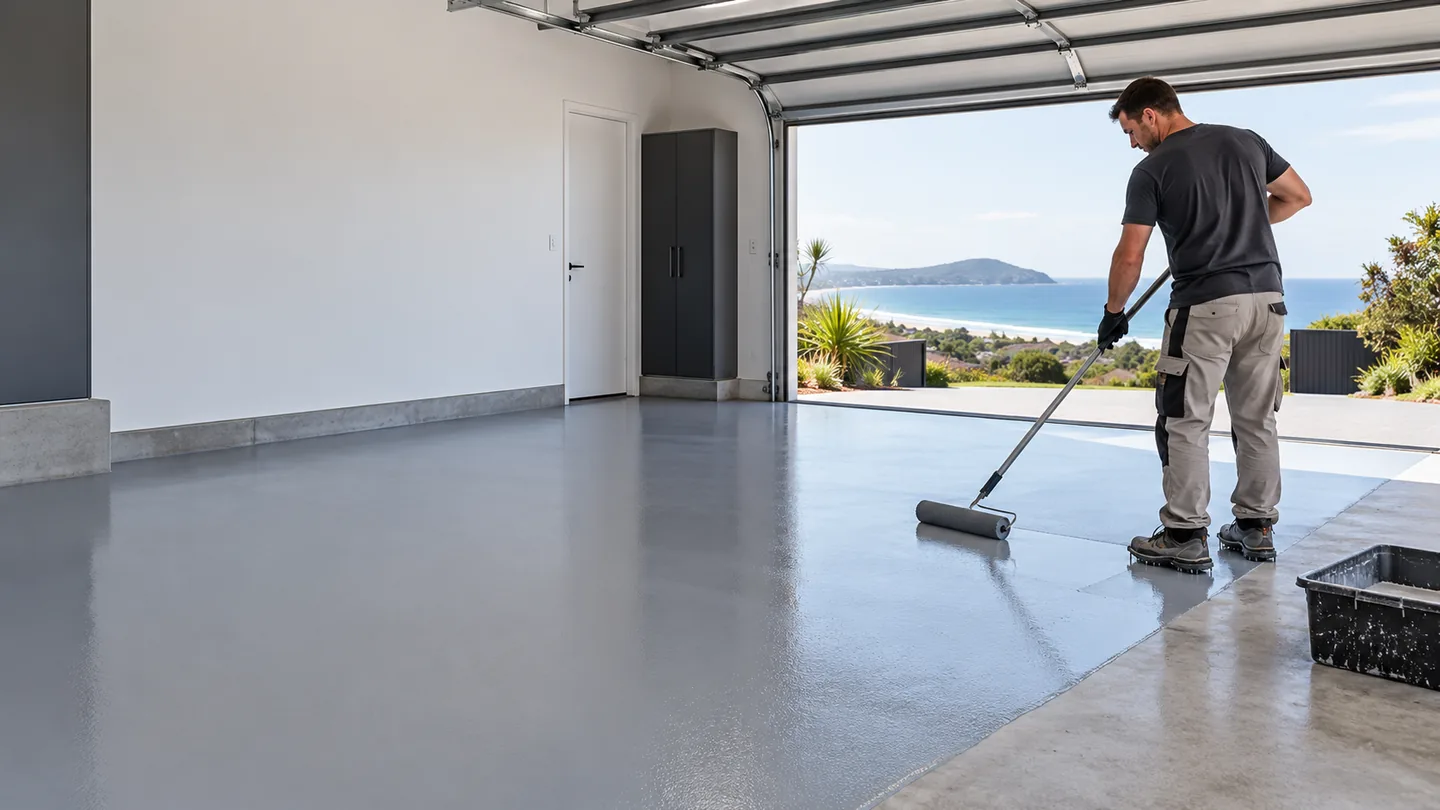
- Topcoat and cure. A protective topcoat goes on, with anti-slip additive or UV-stable product where needed, then the floor cures.
- Handover. You are told when the floor can take foot traffic, vehicles and full use, and how to look after it.
How long it usually takes
Typical timings for a standard garage floor. Bigger, damaged or commercial floors take longer, and your installer will confirm timing on your quote.
| Stage | What happens | Typical time | What you need to do |
|---|---|---|---|
| Quote | Contact, site visit or photos, then the quote | Usually within a few days | Send photos and be available for a visit |
| Preparation | Grinding, coating removal and repairs | Often most of the first day on a garage | Clear the floor and move vehicles out |
| Coating | Base coat, flake or colour, topcoat | Usually one to two more days on a garage | Keep people, pets and vehicles off the floor |
| Cure | The coating hardens | About a day for light foot traffic; several days for vehicles | Follow the cure times you are given |
Before you accept a quote, ask for
- A certificate of currency for public liability insurance
- The coating system and products, by name
- How the slab will be prepared, and whether grinding is included
- Cure times before foot and vehicle traffic
- Warranty terms in writing
After handover
- Keep off the floor until the cure times you were given have passed
- Sweep or vacuum grit regularly
- Mop with a pH-neutral cleaner, or the one your installer recommends
- Clean up oil, fuel and chemical spills promptly
- Use pads under stands and heavy equipment
Process questions
Do I have to be home for the work?
Usually only at the start and at handover, as long as your installer has access. Agree the details with them when you book.
Is a site visit always needed?
Most floors are quoted after a visit, because slab condition affects the price. Smaller jobs can sometimes be priced from good photos.
What if the slab turns out to be damp?
Your installer may recommend a moisture-tolerant primer or other treatment, which can change the price. That is why a moisture check comes before coating.
Who do I contact after the job?
The installer who did the work. Any warranty is given by them, in writing, with your quote.
Start with a free quote
Send the short form and a local epoxy specialist will contact you to talk through your floor.
Get a free quote
Four details are all we need to get started. A local epoxy specialist will contact you to arrange your free quote.